


It’s that time – again.
The 2026 Florida Building Code 9th Edition will take effect on December 31, 2026, bringing with it updates that could affect how structural components are designed, analyzed, and documented throughout the state. For engineers, truss designers, and component manufacturers, understanding these changes is essential to ensure compliance to avoid costly project disruptions while preparing design workflows for the code cycle.
Released late June of 2026, the final PDF of the code publication adopts several updates to standards that will impact the structural building and truss industry, including:
- National Design Specification for Wood Construction ANSI/AWC NDS 2024
- Building Component Safety Information (BCSI) 2018, Updated March 2020
- Minimum Design Loads and Associated Criteria for Buildings and Other Structures ASCE/SEI 7-2022
- National Design Standard for Metal Plate Connected Wood Truss Construction ANSI/TPI 1-2022

NDS 2024 includes notable updates to shear design for bending members, changes to the connections between multi-ply members, and new fire design provisions.
The state of Florida’s adoption of ASCE/SEI 7-2022 in the previous code cycle, positioned the state to address significant wind load changes in the standard. As a result, the code already accounts for the revisions to components and cladding wind pressures for shallower pitched roofs, as well as the simplification of zones for the external pressure coefficient. ASCE/SEI 7-2022 also introduces a new Chapter 32, which establishes tornado wind load requirements for Risk Category III and IV structures to enhance resilience.
This article focuses on the changes introduced in ANSI/TPI 1-2022. While the updated standard includes numerous revisions, several are expected to have a more direct impact on truss design and engineering workflows during the transition from previous editions. To better understand the revisions, this article examines the four key areas: plating, web reinforcement, multi-ply girders, and person load requirements. Together, these topics represent some of the most consequential revisions designers and engineers should understand as they prepare to adopt the new standard. Figure 1 illustrates the projected impact of these changes on truss design.
Plating
Joint Modeling and Structural Behavior. TPI 1-2022 allows most truss plate joints to be treated as rigid but requires flexibility to be considered for floor trusses with narrow-face plating. These revisions improve the alignment between analytical predictions and actual in-service performance, resulting in more reliable and consistent truss designs.
Effective Depth of Chord Member. While NDS focuses on wood member stresses, TPI expands the design framework by incorporating plate/joint checks that account for tension perpendicular to grain.
Rolling Shear. TPI addresses shear stress perpendicular to grain by creating a horizontal shear volume factor, CV. This will mostly affect top chord bearings.
Steel Thickness Reduction. The plate thickness is being reduced by 0.0003 inches. Out-of-plane plate capacity of truss plate – 65 pounds/inch per pair. Under TPI 1-2022, when metal plates are installed on both faces of a joint and meet minimum tooth and size requirements, they can be assumed to resist 65 pounds per inch along the plate’s length for loads acting perpendicular to the plate. This update removes ambiguity and provides a consistent, standardized method for evaluating out-of-plane loading conditions such as wind, bracing, and construction loads.
Web Reinforcement
Web Member Reinforcement to Increase Buckling Capacity. TPI 1-2022 expands and clarifies the design of web member reinforcement for buckling, providing more guidance than TPI 1-2014. The updated standard now applies to both webs (or studs) with and without lateral loads and includes changes in how reinforcement is considered in structural analysis.
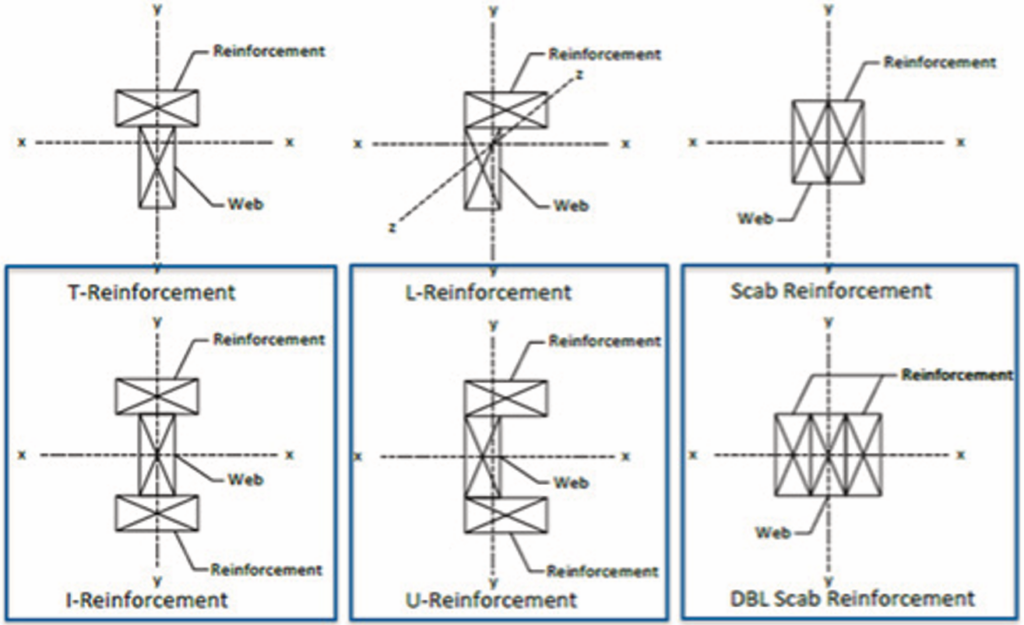
A key update is the introduction of three new reinforcement types; I-Reinforcement, U-Reinforcement, and Double Scab (DBL) Reinforcement (see Figure 2). These new reinforcements provide designers with more options to efficiently address buckling. In addition, TPI 1-2022 standardizes fastening requirements, including minimum nail size and spacing, improving consistency and reliability in the field (see Figure 3).
Multi-Ply Girders
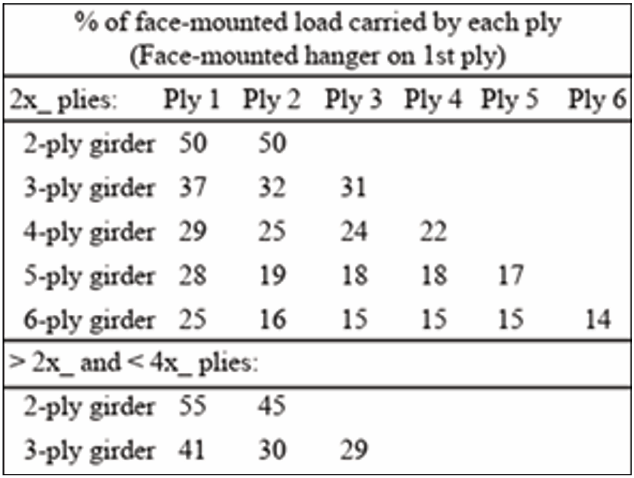
TPI 1-2022 introduces clearer and more structured guidance for multi-ply truss behavior, particularly for side-loaded girder trusses. Section 7.5.2.4 refines limits on the number of plies and load distribution across them.
For member design, TPI 1-2022 moves away from equal load distribution and requires higher load assignment to individual plies to better capture real behavior (see Figure 3). However, for fastener (ply-to-ply connection) design, the traditional 1/n load distribution assumption remains as a practical and conservative approach.
Additionally, new Section 7.5.3.7 introduces an allowable bending stress increase for multi-ply trusses, recognizing improved performance due to load sharing. This increase varies by chord type and number of plies, providing a more realistic and efficient design approach for multi-ply systems.
Reducing 3-ply girders to 2-ply serves as an allowable cost benefit consideration. Obviously, this will increase lumber and plate quantities, but compared to the 3-ply design, this could be beneficial.
Personal Loading
Section 6.2.2.5 now requires a 300 pound (lbs) person load applied to trusses with these conditions:
a. Trusses spanning 18’ or more
b. Load applied to chords with no structural wood sheathing
c. 300 lbs mid panel point load
d. 300 lbs point load to be run concurrently with all dead loads
e. Load case can be run with a duration factor of 1.6 or less
This raised many questions that required clarification from TPI. Here are some of the questions posed by Alpine® and the truss industry:
a. Is this load post construction?
b. What is meant by spanning?
c. Is this point load supported by one truss?
d. What about panels that are not accessible?
e. What consideration should be taken for sloping chords?
f. Where do purlins fall regarding structural wood sheathing?
The TPI Technical Advisory Committee (TAC) issued a technical interpretation on February 6, 2026. Here are some of the clarifications TPI provided:
a. If the trusses are spaced 30” or less, the 300 lbs point load would be supported by 2 trusses.
b. If the panel can accommodate a 42” x 24”rectangular space, then the person load needs to be applied.
c. If the slope on the bottom chord is less than 2/12, the person load is required.
d. Spanning is defined as being between bearings, not the overall truss span.
e. If purlins are spaced greater than 24” on-center or there is no structural wood sheathing, the person load is required.
The 2026 Florida Building Code represents another step in an ongoing effort to improve structural performance, safety, and consistency across projects. Although many of the changes discussed are technical in nature, their impact on design, engineering, and compliance can be significant. With each code cycle, preparation and education remain key to successful adoption. For questions or additional information, please contact the Alpine® Engineering Team.
Reference(s)
1 Florida Building Code, 9th Edition (2026)
2 National Design Specification for Wood Construction ANSI/AWC NDS 2024
3 Building Component Safety Information (BCSI) 2018, Updated March 2020
4 Minimum Design Loads and Associated Criteria for Buildings and Other Structures ASCE/SEI 7-2022
5 National Design Standard for Metal Plate Connected Wood Truss Construction ANSI/TPI 1-2022